tokenwise routes every piece of coding work to the right model and effort, across Claude, ChatGPT Codex, Gemini and free models. When one plan runs low, the work moves on to the next.
Works with the plans you already have
Grepping a repo doesn't need your strongest model. Debugging a race condition does. tokenwise makes that call for every piece of the job.
Type what you want in plain words. The orchestrator (Claude) reads the project and splits the work.
Each piece goes to the cheapest worker that can do it well, in its own git worktree.
Nothing touches your project until you approve it. Per-file diffs, one click to apply, one to commit.
A plan near its limit or a rate-limit error moves the job to the next worker: Codex, Gemini, Claude, then free models.
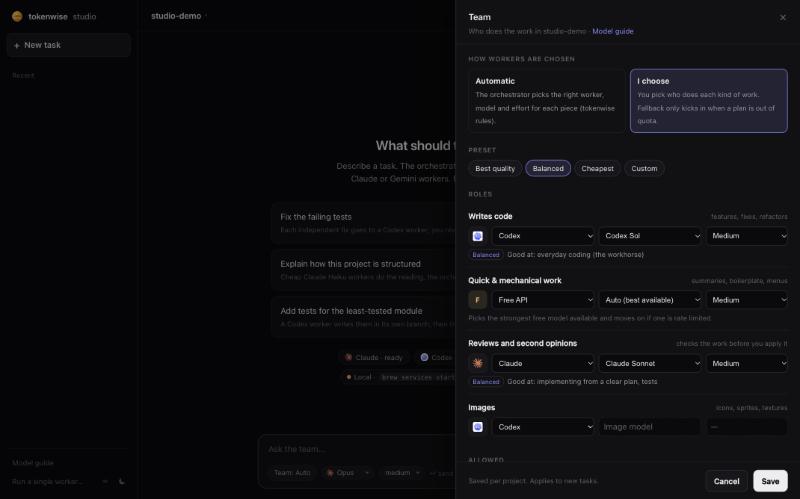
Opus at low for a quick judgment call, Sonnet at high for a big routine refactor. Effort is chosen per piece, not per session.
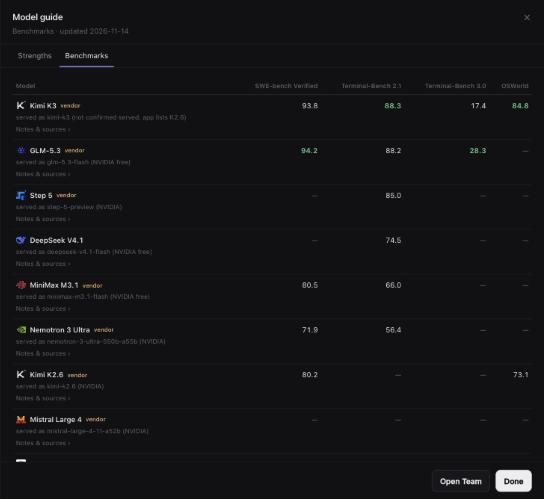
Free NVIDIA models (GLM, Step, DeepSeek…) read and edit files in a sandboxed worktree, ranked by Terminal-Bench. Opt-in.
The orchestrator can't edit your files. Every change comes from a worker you review before it lands.
See your Claude and ChatGPT 5-hour and weekly usage in the sidebar, read from the CLIs themselves.
Automatic mode, or choose who writes code, who reviews and who draws images, with Best quality, Balanced and Cheapest presets.
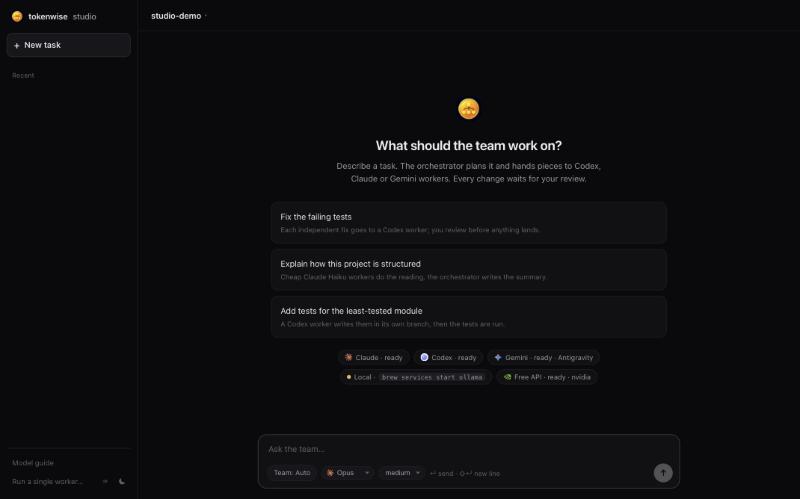

Use the skill inside the agent you already like, or the studio to run a whole team from one screen. They work great together, and each works on its own.
A local web app: one orchestrator, many workers, live progress, per-file review and plan limits.
A skill for Claude Code, Codex CLI and Gemini CLI that picks the model and effort for each piece of work and hands it to cheaper subagents and other CLIs.
Yes. tokenwise and tokenwise studio are open source (MIT). They run on your machine and use the plans and CLIs you already have; there is no tokenwise account or server.
On small tasks the overhead is about even; the savings come from long sessions with lots of reading, where mechanical work goes to cheaper models and other plans. We publish our benchmark harness so you can measure it on your own work.
Only if you opt in. Free models are off until you add a key and set TOKENWISE_ALLOW_FREE=1, because free tiers may use prompts for training. They also never see secrets like .env files or keys.
Workers that edit files work in their own git worktree. Nothing reaches your project until you review the diff and press Apply, and applied changes are staged, not committed.
Node 20+, git, and at least one of Claude Code, the Codex CLI or Google Antigravity, signed in. macOS is the most tested platform.
Install it in a minute and let your plans go further.